MSU Graduate’s Environmental Startup Wins BIKE-HEI Innovation Award
Digital transformation and the responsible use of natural resources are increasingly becoming integral elements of a unified strategy for sustainable development. In today’s rapidly changing world, Mariupol State University fully embraces the principles of environmental responsibility.
The second phase of the international initiative “Boosting Innovative and Knowledge-Based Entrepreneurship in Higher Education Institutions” (BIKE-HEI) is drawing to a close. This spring, MSU students, faculty members, and alumni had the opportunity to participate in the second Innovation and Entrepreneurship Award competition and compete for financial support from the European Institute of Innovation and Technology (EIT) to develop their startup ideas.
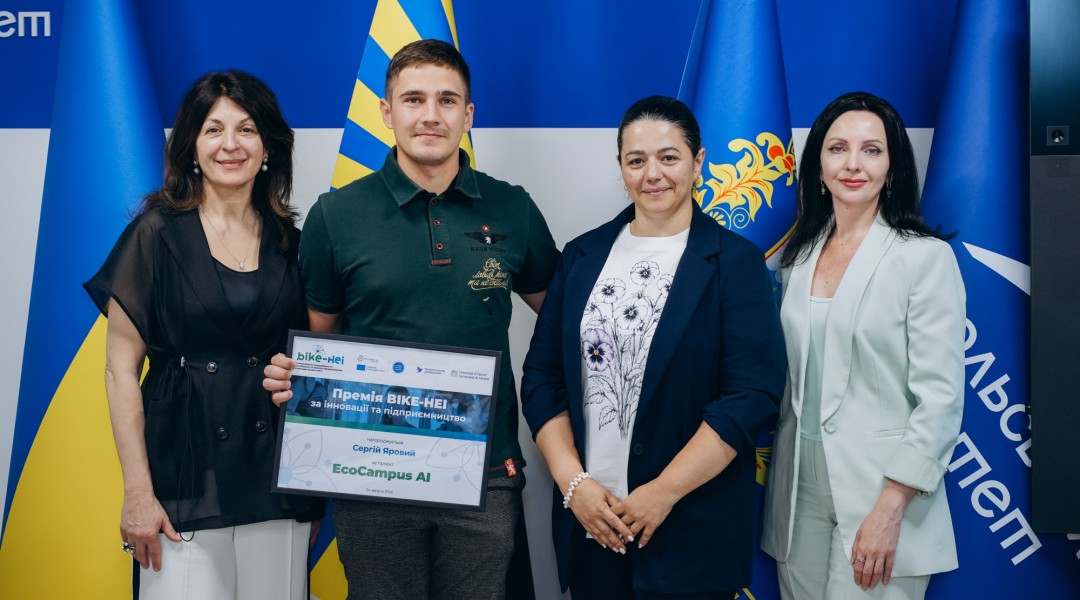
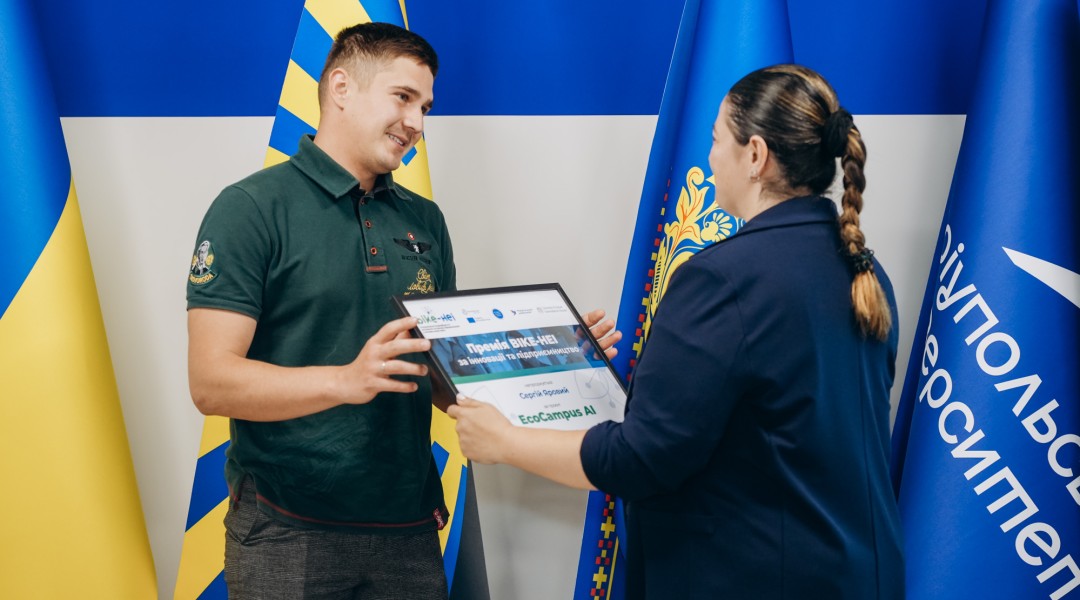
One of the award winners was Serhii Yarovyi, a graduate of the Environmental Science program and currently Head of the Veterans Support Center at Mariupol State University. His project, EcoCampus AI, proposes the creation of an intelligent energy management platform for university campuses.
As a result of Russia’s full-scale invasion, Ukrainian higher education institutions face continuously rising energy costs while also striving to meet international sustainability standards and reduce their carbon footprint. Although many universities already operate individual energy monitoring systems, they often lack a unified digital solution capable of providing comprehensive energy management.
Mariupol State University has already introduced several components of an energy-efficient infrastructure equipped with API-enabled data access. This creates a solid foundation for developing a Minimum Viable Product (MVP) without the need to build an entirely new infrastructure.
The project is designed to reduce energy consumption and optimize utility costs. Electricity, heating, and other resources will be managed more efficiently, lowering operational expenses while creating a smarter, more comfortable, and environmentally responsible campus.
Beyond improving energy efficiency, the project will also encourage a shift toward environmentally conscious behavior. Students will be able to see how modern technologies can genuinely improve everyday life, allowing them not only to study but also to feel that they are part of something meaningful,
— says Serhii Yarovyi.
EcoCampus AI is an intelligent energy management platform that combines geographic information systems (GIS), artificial intelligence, the Internet of Things (IoT), API integrations, and big data analytics. The platform will collect information from energy systems, smart meters, sensors, weather services, and internal university APIs to generate a real-time digital map of campus energy consumption.
Unlike conventional monitoring systems, EcoCampus AI will not simply collect statistics. It will provide predictive analytics by forecasting resource consumption, modeling the effectiveness of energy-saving measures, prioritizing infrastructure upgrades, evaluating return on investment, and automatically generating ESG reports.
For its innovative approach and commitment to the principles of green entrepreneurship, Serhii Yarovyi was awarded the BIKE-HEI Innovation Award. He plans to implement the project together with colleagues from the university’s Educational Technology Department.
In the future, EcoCampus AI has the potential to expand far beyond our university. I would like to develop a solution that can be adopted by other higher education institutions seeking to become more modern, environmentally responsible, and energy-efficient. Over time, the project could evolve into a shared platform for a network of ‘green universities,’ a climate-tech solution for the region, or a digital system supporting sustainable campus management. It could also become a product of interest to universities across Eastern Europe,
— the startup’s creator concludes.








Останні новини: